Live Webinar- Through the Eyes of the Adversary: Breaking and Defending Identity
White logo for Radiant Logic featuring geometric lines forming a starburst shape on the left and the words Radiant Logic in bold, uppercase letters on the right, all on a light gray background.
  • Platform
      • Explore the RadiantOne
Platform
      • Identity Data Management
      • Identity Observability
      • Identity Analytics
        • Identity Analytics Overview
        • AI Data Assistant (AIDA)
      • Platform Architecture
        • Platform Architecture Overview
        • Deployment
        • Integrations
          • Blueprint: RadiantOne & CyberArk
          • Blueprint: RadiantOne & Okta
          • Blueprint: RadiantOne & SailPoint
        • Getting Started
  • Solutions
      • Solutions
Overview
      • Security
        • Security Overview
        • Mergers & Acquisitions
        • Zero Trust Initiatives
        • Identity Observability & Remediation
        • Non-human Identities
        • CISO Dashboard & Reporting
      • Operations
        • Operations Overview
        • Accelerate IAM & IGA Deployments
        • Modernize Identity Infrastructure
          • Connect Hybrid & Multicloud Architectures
        • Identity Data Warehouse
        • Active Directory Consolidation
        • Workforce Productivity
      • Governance & Compliance
        • Governance & Compliance Overview
        • Access Review
        • Audit Trail & Reporting
        • Control Privileged Accounts
        • Identity Compliance Controls
        • Role Mining
        • Segregation of Duties (SoD)
      • Industries
        • Industries Overview
        • Finance & Insurance
        • Public Sector
        • Healthcare & Biotech
        • Entertainment & Telecom
        • Energy and Manufacturing
        • Retail
  • Why Radiant Logic
      • Why Radiant Logic
      • Identity Security Posture Management
      • Identity Data Fabric
      • Identity Visibility and Intelligence Platform
  • Partners
  • Resources
      • Resources Overview
      • Resources
        • Resources
        • Webinars
        • White Papers
        • Videos
        • Data Sheets
        • Case Studies
        • Analyst Reports
      • Blogs
      • Events
      • Glossary
  • Company
      • Company
Overview
      • About Us
        • About Us Overview
        • Leadership
        • Awards and Recognition
        • Security Practices
      • Customer Success
        • Customer Success Overview
        • Customer Support
        • Professional Services
        • Training & Enablement
        • Customer Experience
        • Developer Portal
      • News
      • Careers
      • Contact Us
  • Request a Demo
  • Platform
      • Explore the RadiantOne
Platform
      • Identity Data Management
      • Identity Observability
      • Identity Analytics
        • Identity Analytics Overview
        • AI Data Assistant (AIDA)
      • Platform Architecture
        • Platform Architecture Overview
        • Deployment
        • Integrations
          • Blueprint: RadiantOne & CyberArk
          • Blueprint: RadiantOne & Okta
          • Blueprint: RadiantOne & SailPoint
        • Getting Started
  • Solutions
      • Solutions
Overview
      • Security
        • Security Overview
        • Mergers & Acquisitions
        • Zero Trust Initiatives
        • Identity Observability & Remediation
        • Non-human Identities
        • CISO Dashboard & Reporting
      • Operations
        • Operations Overview
        • Accelerate IAM & IGA Deployments
        • Modernize Identity Infrastructure
          • Connect Hybrid & Multicloud Architectures
        • Identity Data Warehouse
        • Active Directory Consolidation
        • Workforce Productivity
      • Governance & Compliance
        • Governance & Compliance Overview
        • Access Review
        • Audit Trail & Reporting
        • Control Privileged Accounts
        • Identity Compliance Controls
        • Role Mining
        • Segregation of Duties (SoD)
      • Industries
        • Industries Overview
        • Finance & Insurance
        • Public Sector
        • Healthcare & Biotech
        • Entertainment & Telecom
        • Energy and Manufacturing
        • Retail
  • Why Radiant Logic
      • Why Radiant Logic
      • Identity Security Posture Management
      • Identity Data Fabric
      • Identity Visibility and Intelligence Platform
  • Partners
  • Resources
      • Resources Overview
      • Resources
        • Resources
        • Webinars
        • White Papers
        • Videos
        • Data Sheets
        • Case Studies
        • Analyst Reports
      • Blogs
      • Events
      • Glossary
  • Company
      • Company
Overview
      • About Us
        • About Us Overview
        • Leadership
        • Awards and Recognition
        • Security Practices
      • Customer Success
        • Customer Success Overview
        • Customer Support
        • Professional Services
        • Training & Enablement
        • Customer Experience
        • Developer Portal
      • News
      • Careers
      • Contact Us
  • Request a Demo
Blue background with intersecting glowing lines and points of light, resembling a digital network or abstract representation of data connections.

Radiant Logic’s SCIM Support Recognized in 2025 Gartner® Hype Cycle™ for Digital Identity

August 7, 2025/in Blog Anders Askasen/by Josue Ochoa

The 2025 Gartner Hype Cycle for Digital Identity talks about the growing need for standardization in identity management—especially as organizations navigate fragmented directories, cloud sprawl, and increasingly complex hybrid environments. Among the mentioned technologies, SCIM (System for Cross-domain Identity Management) stands out as a foundational protocol for modern, scalable identity lifecycle management. 

Radiant Logic is proud to be recognized in this report. Our platform’s robust SCIMv2 support positions RadiantOne as a key enabler of identity automation, built on open standards and enterprise-proven architecture. 

Why Standardized Identity Management Matters 

SCIM was introduced to replace earlier models like SPML, offering a RESTful, schema-driven protocol to streamline identity resource management across systems. It defines a consistent structure and a set of operations for creating, reading, updating, and deleting (CRUD) identity resources such as User and Group. 

Today, SCIM is broadly adopted by SaaS and IAM platforms alike. It reduces manual effort, eliminates brittle custom integrations, and strengthens governance and compliance through standardized lifecycle operations. 

Without SCIM—or a consistent identity abstraction layer behind it—organizations are forced to manage identities with ad hoc connectors, divergent schemas, and fragile provisioning scripts. Gartner rightly identifies SCIM as essential to achieving identity governance at scale, enabling consistent policy enforcement and lowering operational risk. 

Radiant Logic’s SCIM Implementation 

RadiantOne delivers full SCIMv2 support, allowing organizations to extend standardized provisioning across their entire environment—cloud, on-prem, and hybrid—without rearchitecting existing infrastructure. 

As both a SCIM client and server, RadiantOne can expose enriched identity views to downstream applications or ingest SCIM-based data from external sources for correlation and normalization. This bidirectional flexibility eliminates the need for custom connectors and hardcoded integrations. 

At the core is RadiantOne’s semantic identity layer, which unifies identity data across sources, ensures consistency, and drives intelligent automation. This data foundation supports not only SCIM-based lifecycle management, but also Zero Trust access control, governance workflows, and AI-driven analytics. 

Where RadiantOne and SCIM Deliver Real Value 

Here are six practical use cases where Radiant Logic’s SCIM support drives immediate impact: 

Accelerated Onboarding with Trusted Identity Data 

  • RadiantOne consolidates authoritative sources—HR, AD, ERP, SaaS—into a single, richly structured identity record. That record is exposed over SCIM v2 (or any preferred connector) to the customer’s existing join-move-leave engines—IGA, ITSM, or custom workflows—so they grant birth-right access through the tools already built for approvals and fulfillment.  
  • Offering complete and accurate provisioning with minimal integration effort, RadiantOne stays focused on delivering clean, governed identity data rather than duplicating workflow logic.

From SSO to Lifecycle Management 

  • SSO controls access, but SCIM controls who gets access. RadiantOne aggregates and enriches identity data from sources like Active Directory, LDAP, and HR systems, making it available to SCIM-enabled applications. Provisioning decisions are based on accurate, policy-aligned identity, ensuring access is granted appropriately from the start. 
  • This closes the gap between authentication and authorization, reducing overhead and aligning with Zero Trust principles. 

Simplifying Application Migrations 

  • RadiantOne delivers a clean, normalized identity record and, through its enriched SCIM v2 interface, maps every attribute name and value to the exact schema and format the target expects. This built-in translation removes custom scripts, connector rewrites, and brittle middleware, so admins can load thousands of users into new SaaS platforms quickly during M&A, re-platforming, or app consolidation. 
  • Admins can provision thousands of users into SaaS platforms efficiently, making this ideal for M&A, re-platforming, or app consolidation. 

Real-Time Updates as Identity Changes 

  • RadiantOne keeps identity data current as roles change or users depart. Apps simply ask RadiantOne via SCIM v2 for the latest record—no custom sync jobs or code—so they can enforce least-privilege and de-provision on time while their own workflows remain untouched. 
  • This ensures timely de-provisioning and continuous enforcement of least-privilege access. 

Precision Access for Governance and PAM 

  • Provisioning isn’t just account creation—it’s about controlled access. RadiantOne adds business context to identity data, such as org structure, clearance, and location, so SCIM can support fine-grained entitlements. 
  • This aligns with PAM policies, improves audit readiness, and enhances IGA and analytics accuracy. 

Keeping Workflows and Business Logic in Sync 

  • SCIM also supports operational workflows. RadiantOne keeps identity attributes—like manager relationships, email, or job status—accurate across systems.  
  • This ensures approval chains, directories, and collaboration tools function correctly without manual updates.

Conclusion

Radiant Logic’s SCIM implementation is already powering identity automation in some of the world’s most complex IT environments, proving its value in delivering standards-based, high-integrity identity infrastructure. Book a demo to explore how Radiant Logic’s SCIM-enabled identity platform can transform your organization’s identity management practices, drive operational excellence, and secure your digital identity future. 


Disclaimers: 

Gartner does not endorse any vendor, product or service depicted in its research publications and does not advise technology users to select only those vendors with the highest ratings or other designation. Gartner research publications consist of the opinions of Gartner’s research organization and should not be construed as statements of fact. Gartner disclaims all warranties, expressed or implied, with respect to this research, including any warranties of merchantability or fitness for a particular purpose. 

GARTNER is a registered trademark and service mark of Gartner and Hype Cycle is a registered trademark of Gartner, Inc. and/or its affiliates in the U.S. and internationally and are used herein with permission. All rights reserved. 


Abstract digital art showing swirling blue dots forming a dynamic, wave-like pattern on a dark purple background, creating the illusion of motion and depth with a central empty space.

How to Reverse IAM Technical Debt & Stop a Security Crisis

July 7, 2025/in Blog Anders Askasen/by Josue Ochoa

There is a growing problem lurking in your identity infrastructure—one that doesn’t trigger alerts, isn’t flagged by vulnerability scanners, and yet quietly compounds security vulnerabilities: IAM technical debt. 

Why IAM Technical Debt is a Growing Risk

It is not just a side effect of legacy systems anymore. It is a direct result of the growing gap between rapid digital transformation and the brittle, aging identity plumbing beneath it. According to the 2025 Verizon Data Breach Investigations Report, stolen credentials were involved in 88% of web application attacks—reinforcing identity as the top threat vector. But now, Gartner adds another critical lens. 

In their June 2025 research GTP report, Reduce IAM Technical Debt1, Gartner® analysts Nat Krishnan and Erik Wahlstrom warn that “technical debt weakens the agility of an IAM team and the effectiveness of organizational security controls.”  In our opinion, their findings highlight the same five culprits we see in the field every day: siloed tools, outdated integrations, incomplete identity discovery, poor IAM hygiene and inconsistent application onboarding. 

When identity becomes fragmented, so does control—and without control, it defeats the very purpose of why we do IAM in the first place.  

What Is IAM Technical Debt, Really? 

To explain what technical debt is, think of it as the accumulated cost of shortcuts: ad-hoc integrations and workarounds, siloed tools, rushed deployments and postponed cleanup. It forms slowly, but the result is predictable. When left unchecked, it creates operational drag, governance blind spots, increased threat surface and catastrophic risk exposure.  

Common Causes of IAM Technical Debt: Here’s What Drives It 

  • Custom and siloed IAM tools that don’t communicate
  • Legacy and nonstandard apps still critical to operations but incompatible with modern identity governance
  • Incomplete discovery of identities and entitlements
  • Weak hygiene around least-privilege, access reviews and MFA
  • Fragmented onboarding of apps and services into IAM systems

When identity becomes fragmented, so does control. And in today’s cloud-first, hybrid-everything reality, that is both inefficient and dangerous. 

From Sprawl to Strategy: Reclaiming Identity Control 

Fixing IAM technical debt isn’t about ripping and replacing—it’s about rethinking identity as a data problem and solving it with the right architecture.

Four Practical Steps to Rebuild IAM on a Stronger Foundation

Based on both industry research and hands-on field experience, the path forward includes four critical steps: 

  • Identify your silos: Map out identity sources—across AD forests, cloud apps, legacy tools, shadow IT—and expose where the cracks begin
  • Consolidate and virtualize: Aggregate fragmented data into a unified identity data lake. Use abstraction to simplify integration and reduce your connector footprint
  • Control identity sprawl: Build bridges, not walls—stitch together disparate identity records without replacing systems and bring order to the chaos
  • Orchestrate across the mess: Govern consistently across central and distributed environments, enabling context-rich enforcement no matter where access decisions happen

How Radiant Logic Eliminates IAM Technical Debt

Radiant Logic’s platform RadiantOne was built to solve this problem and to unify, enrich and activate identity data. 

RadiantOne virtualizes all identity sources into a single semantic layer—whether they come from AD, LDAP, Azure AD, Okta, SaaS applications or custom databases. It then brings real-time observability to the identity layer, enabling you to spot risky access patterns, automate entitlement cleanup and surface context-rich insights to stakeholders before an auditor or attacker finds the gap to exploit. 

With RadiantOne: 

  • You turn fragmented identity data into a governable, observable asset
  • You gain line-of-sight across humans, machines, and APIs
  • You eliminate the root causes of IAM project failures and identity-related incidents

Final Thought: Identity Debt is Not Just IT’s Problem 

IAM technical debt isn’t just a nuisance—it’s a strategic liability. It stalls digital transformation and cloud projects, burdens compliance and weakens your security posture. But with the right foundation, it can be reversed. 

Ready to act? Schedule a demo of RadiantOne and start reducing your identity debt today. 


1: Gartner, Reduce IAM Technical Debt, ID G00798396, June 23, 2025, by Nat Krishnan and Erik Wahlstrom. GARTNER is a registered trademark and service mark of Gartner, Inc. and/or its affiliates in the U.S. and internationally and is used herein with permission. All rights reserved. 


Abstract digital background featuring a blue gradient with small glowing dots, geometric lines, and nodes, transitioning to a bright orange-yellow area on the right side.

Architecting a Data-Centric Identity Security Infrastructure

June 20, 2025/in Blog Sebastien Faivre/by Josue Ochoa

Architecting a Data-Centric Identity Security Infrastructure 

As organizations build more interconnected digital ecosystems, securing identity is no longer just a component of cybersecurity—it is the foundation of protecting everything from data to devices. We are now seeing an unprecedented proliferation of machine identities, which frequently outnumber human identities. Yet traditional identity systems struggle to manage these effectively.  

Organizations grapple with fragmented, siloed identity data sources and IAM solutions leave blind spots and inefficiencies. The flexibility of using AI and mobile or personal devices for business operations further aggravates this issue.  

These security concerns become a critical pain point for larger enterprises that want to scale. Mergers and acquisitions complicate matters by combining disparate identity systems and policies. It frequently leads to conflicting identity data and compromised access management, posing severe security risks.  

What is the solution to making an organization’s identity security practices more effective and resilient, not just for the current threat landscape but also for next-gen risks?

The answer is to architect a data-centric identity security infrastructure, making identity data the cornerstone of all security decisions.

The Need for a Data-Centric Identity Security Infrastructure 

Traditionally, enterprises have addressed identity security problems individually, implementing separate solutions for Identity Governance and Administration (IGA), Privileged Access Management (PAM), access management, and SaaS-native systems like Microsoft Entra and Okta. Although individually functional, these tools collectively create fragmented identity data silos. As identity and application counts grow, these silos generate significant security gaps due to inconsistent data visibility and management. 

The solution lies in making identity data foundational. Identity data must be positioned at the core of every security decision, ensuring consistency, accuracy, and completeness across all processes related to authentication, authorization, and lifecycle management. 

The goal is to perfectly align with Gartner’s definition of identity-first security—an approach positioning identity-based access control as the cornerstone of cybersecurity. 

Implementing Gartner’s VIA Model 

To achieve data-centric identity security, Gartner’s VIA model (Visibility, Intelligence, Action) provides a clear and structured roadmap: 

  1. Visibility: Establishing unified identity data visibility
  2. Intelligence: Analyzing data for actionable insights 
  3. Action: Executing real-time remediation based on intelligence

Each component is crucial for successful deployment. 

Visibility: Consolidating Fragmented Identity Data 

Organizations must first tackle fragmented identity data scattered across various sources—Active Directory, HR systems, PAM solutions, and cloud identity solutions. Consolidating these into an identity data lake is critical. This data lake must be data-agnostic, scalable, real-time, event-driven, and capable of handling vast volumes of data, both structured and unstructured. 

Once consolidated, raw identity data needs to be transformed into actionable information via a semantic layer. A semantic layer is a structured representation or model that organizes identity data into meaningful relationships and context. It turns fragmented, raw data into unified, easily understood information. 

In short, this semantic layer maps identity data into a coherent model providing unified visibility across human and non-human identities, entitlements, and actual usage. It must: 

  • Ensure that diverse identity data is standardized and unified 
  • Break data silos by treating access uniformly, regardless of its source 
  • Leverage a graph-based structure for intuitive, multi-dimensional navigation 
  • Maintain data lineage for precise traceability and remediation 

Intelligence: Identifying and Observing Anomalies 

The semantic layer significantly improves data coherence but often results in large volumes of information that are challenging to analyze manually. For this reason, the Intelligence layer’s role is crucial. It continuously observes identity data, focusing specifically on detecting: 

  • Deviations 
  • Discrepancies 
  • Unauthorized or abnormal changes 
  • Risky behavior 

Organizations benefit less from routine events than from abnormal situations requiring immediate attention. Intelligence leverages queries, usage analysis, change detection, peer group baselining, and correlation techniques.  

Observations enrich the semantic layer, enhancing decision-making in downstream systems such as PAM, IGA, and access management platforms by providing crucial context around potential risks and anomalies. 

Action: Executing Flexible Remediation 

The Action layer addresses identified issues based on intelligence. This step requires a flexible approach, capable of adapting to different scenarios. Some actions may be straightforward, such as directly writing corrections back to endpoint systems. Others require interaction with existing cybersecurity tools—IGA, PAM, or ticketing systems—emphasizing the importance of well-maintained connectors and integrations. 

Remediation often critically requires consensus from stakeholders beyond IT security teams. Engaging the business stakeholders—the first line of defense, such as line managers and resource owners—is essential to distinguish legitimate threats from false positives. This engagement transforms the security system into a collaborative “security cockpit,” amplifying the cybersecurity team’s capabilities. 

Effective collaboration requires clear roles and responsibilities across all stakeholders, ensuring that ownership and accountability are well defined when addressing identity security risks. Additionally, seamless integration with everyday digital workplace tools like Slack or Microsoft Teams, possibly enhanced by LLM-based conversational interfaces, can significantly streamline interactions, enabling quick confirmations and decisions from non-technical stakeholders. 

Strengthening Identity Security with a Data-Centric Approach 

Building a data-centric identity security infrastructure using Gartner’s VIA model provides comprehensive benefits: 

  • Unified Visibility: Eliminates fragmented silos, creating a coherent identity view
  • Actionable Intelligence: Proactively identifies risks and anomalies, enhancing threat detection
  • Real-time Remediation: Ensures quick, precise actions tailored to diverse cybersecurity scenarios
  • Collaborative Remediation: Actively involves non-technical stakeholders, significantly improving accuracy and response effectiveness

Ultimately, by placing identity data at the heart of security infrastructure, organizations significantly strengthen their security posture, achieving genuine, identity-first security. 

How RadiantOne Implements a Data-Centric Identity Security Infrastructure 

The RadiantOne platform simplifies and accelerates the transition to a data-centric identity security model. The solution consolidates identity data from legacy on-premises and cloud-based sources into a unified, standards-based, vendor-neutral identity data lake. This consolidation eliminates identity data silos and provides a global IAM data catalog with rich, attribute-enhanced user profiles. 

With RadiantOne, organizations can efficiently build unlimited virtual views of identity data that are unified across various protocols (LDAP, SQL, REST, SCIM, Web Service APIs). Its low-code/no-code transformation logic enables seamless data mapping, ensuring quick adaptability to changing business and security requirements without disrupting existing systems. 

RadiantOne scales to support hundreds of millions of identities, adding resilience and speed through a highly available, near real-time identity service. The solution automates identity data management, streamlines user and group management, rationalizes group memberships, and dynamically controls access rights. 

Its visibility capability provides a real-time, unified view of the situation for all human and non-human identities down to a permission level. Coupled with its observability capabilities, it spots misconfiguration and detects anomalies or abnormal changes to keep the identity landscape under control. 

Most notably, the platform’s AI-powered assistant, AIDA, simplifies user access reviews, swiftly identifying anomalies and providing actionable remediation suggestions. By automating tedious manual reviews, AIDA drastically reduces administrative effort and improves decision accuracy, making it easier to enforce a least-privilege approach and continuous compliance. 

A digital illustration of intertwining blue light waves with glowing accents on a dark background, creating an abstract, futuristic effect.

Migrating to Data-Centric ISPM

June 16, 2025/in Blog Simon Moffatt/by Josue Ochoa

This is the second in a three-part series of articles looking at the critical need to take a data-centric approach to identity. The first article conveyed why identity and access management in general is rapidly becoming a “big data” problem – and what that means and what benefits can be gained by taking such an approach. 

In this article, we will apply our data-centric approach and understanding to delivering identity security posture management (ISPM). 

The Rise of ISPM 

  • IGA in Distress 
  • ISPM as Evolution 
  • Continuous Compliance 

It is important to define some constraints and capabilities surrounding ISPM and how this relates to both existing IAM infrastructure and to IGA.

ISPM focuses on the preventative and pre-breach control set. This means that it is important to consider that the controls being applied to IAM are being done on the data layer – which often focuses upon identity assurance, data hygiene and permissions life cycle management.

These controls can make a material difference as they pertain to risk impact and things like blast radius. 

The cousin to ISPM in recent years is identity threat detection and response (ITDR). While intricately related –  they are both focused on end-to-end identity, identity risk reduction and holistic protection – ITDR is often more focused on detection and post-breach, using response and controls that often influence in-flight attacks before they are completed. The remediation options available to ITDR and ISPM are often different, too. 

ISPM has emerged in the past 3 years as both an extension and potentially an alternative design pattern to the traditional identity governance and administration (IGA) functions that emerged in the early 2000s. On the back of regulation such as Sarbanes Oxley and the Gramm Leach Bliley act, the US and more recently global financial institutions look to document and automate the “Who has access to what?” question. However, many IGA programs ended up in distress. 

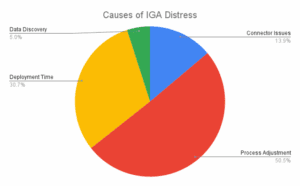
Source: The Cyber Hut Community Poll, April 2024, n=65

The causes are likely to vary depending on project size, sector and requirements, but some consistencies do emerge. Slow deployments, poor connectivity to integrated systems and costly and complex requirements to alter existing business processes all contribute to IGA capabilities that cover only a subset of systems. 

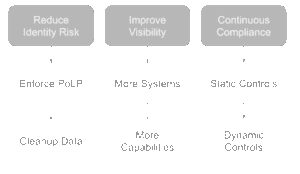
The movement to a more continuous compliance initiative – one that places less emphasis on time consuming periodic reviews – sees ISPM aiming to leverage existing and evolving best practices around data hygiene with the application of both static and dynamic controls.  

The benefits increase as more systems become part of the strategy – whether they be downstream managed applications or orthogonal systems that can provide information that helps deliver more context and insight. 


These economies of scale not only help deliver value by improving identity hygiene, access management and permissions clean-up for more systems, but they also help deliver analytics and insights. These insights are likely to support different stakeholders across the business in their pursuit of productivity improvements, faster application and identity onboarding, risk reduction and security improvements. 

Improving with a Data-Centric View

  • Data Fabric 
  • Insights for Pre-Breach 
  • Prevention as a Strategy 

As we start to imagine a more data-centric approach to both IGA improvements and a strategic ISPM capability, we immediately begin to see both data sources and data consumers across our IAM landscape. As discussed in the first article in this series, a connected data fabric provides a bi-directional set of touch points that supports a conjoined and multiplying effect with respect to understanding how our identities are created, updated, used and managed. Identities (for both humans and non-humans) do not exist in a vacuum and are tightly coupled to business process and task completion.  

However, numerous natural blind spots often exist within this life cycle in many organizations today. For example, this could include a lack of context during access requests, insufficient clarity during access reviews, or uncertainty when removing excessive permissions. Individually, these concerns are significant, but they often result in a cascading set of issues, as downstream systems and reactive detective controls are frequently built on false security assumptions. These false assumptions are implicitly built into relying on party systems, detective controls, and monitoring systems.

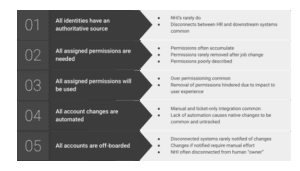
For example, assuming all identities have originated from an authoritative source often removes the secondary validation that helps identify ghost, orphaned, shared and redundant accounts. Downstream systems do not always provide ways of analyzing and questioning permission associations – they are more focused on whether a permission is present against an account in an access control entry. How that permission got there is assumed to be accurate. There is an assumption that removals and changes upstream are to be “automagically” relayed to a host of downstream systems. This is rarely the case. 

These false assumptions and resulting failings in security posture are just some examples of the blind spots that are manifesting on the IAM life cycle management plane. Informed decision making is now possible by leveraging existing data sources across the technology landscape. This data-centric approach can help move organizations to a pre-breach way of reducing identity risk.  

While detective, behavioral, and post-breach (and ideally, real-time breach) capabilities are critical, they must be grounded in strong, reliable identity data. 

Getting Started 

  • Architecture and Concepts 
  • Start Small 
  • Process and Metrics 

Delivering a data-centric IAM framework is a journey. While that may sound like a technological cliché, it is important to realize the factors involved in delivering success here. IAM is gaining in significance from being an operational and tactical component (which is often reactionary) to a strategic fulcrum that delivers productivity, security and revenue-generating opportunities. To that end, people, processes and technology must all change – and often that change will come at different times.  

It is important to deliver each component of this journey in a way that aligns with the business’s current state and needs. This means that processes, workflows, job-specific tasks and ways of working have evolved over a considerable period of time and are inherently optimized based on effort, skill, and knowledge.  

The IAM data foundation must integrate with these factors initially without change. Asking organizations to immediately alter onboarding or application access functions will simply inhibit adoption. Over time, those processes can be altered and optimized once managed within the system. 

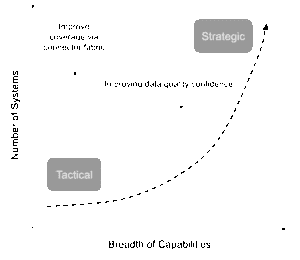
The journey for adoption will cover two main aspects: systems coverage and maturity, but also capability maturity. The integration of more systems is crucial – with some of those systems not having an IAM-centric background such as ISTM or CMDB.  

Secondarily, the maturity of data-centric capabilities in these systems will also grow over time – from an initial reading and correlation of data sources to concepts like predictive analytics and human-in-the-loop, guided clean-up and remediation. The rise of AI is rapid and ever-changing, and organizations are quickly learning how to consume and leverage this new autonomous way of working through agentic AI and RAG-based querying. However, it still takes time to alter governance, operations, and accountability frameworks. 

As with any journey through change, it is also important to quickly and clearly communicate success and metrics to a range of audiences. This will include non-technical stakeholders focused on improving productivity, reducing costs, and enhancing collaboration, as well as those interested in metrics related to risk reduction, connectivity, and overall performance. 

The final article in this series will look at best practices and critical capabilities needed to succeed in this area. 


A glowing blue ring composed of small dots and particles on a black background, creating a futuristic, circular light effect with scattered sparkles radiating outward.

Radiant Logic Unveils Its Next-Generation Chatbot

June 12, 2025/in Blog Dhar Rawal/by Josue Ochoa

Radiant Logic is proud to announce the launch of our new chatbot—a dynamic solution engineered to revolutionize how customers and internal teams interact with data and knowledge. This post offers a high-level look at the core technology powering the chatbot and previews future innovations that will further streamline support, knowledge sharing, and enterprise data interactions. 

Smarter Answers with Retrieval-Augmented Generation (RAG) 

At the heart of our chatbot lies a retrieval-augmented-generation (RAG) engine that adeptly handles user queries. This means the chatbot doesn’t just generate responses – it also pulls in real information from a curated and constantly updated knowledge base to ensure each. The result? More accurate, complete, and trustworthy responses. 

Cutting-Edge Information Retrieval Techniques 

To make sure users get the best possible answers, we use a blend of modern search techniques: 

  • Semantic Search helps the chatbot understand the meaning behind a question—not just the keywords
  • Keyword-Based Search (BM25) ensures that important exact matches are not overlooked
  • Re-ranking using advanced AI models ensures that the most relevant content is always prioritized

Read more about our document search strategy on Medium. 

Built-In Intelligence for Better Answers 

Even the best AI models can occasionally miss the mark. That’s why we have included a “golden-qa” dataset—a collection of frequently asked questions and high-confidence answers that help fill in any gaps and ensure reliable responses to common or complex queries. 

We also use a ReACT agent to fine-tune questions before they are answered, making sure the chatbot clearly understands what is being asked and can follow up intelligently when needed. 

Optimizing Tabular Data Handling 

Many support questions involve structured data like tables—and that is something traditional chatbots often mishandle. Ours includes a unique approach to processing and presenting tabular data, improving clarity and reducing the risk of AI errors. 

Learn more in our evaluation of LLMs and tables on Medium. 

A Robust and Flexible Architecture 

The backbone of our chatbot is a FastAPI-based answering engine designed for speed, scalability, and integration: 

  • A web-based interface is available to customers at chatbot.radiantlogic.com
  • An internal Slack bot helps our teams get rapid answers and manage content directly using simple commands
  • Built-in feedback tools allow users to rate responses, helping us improve the chatbot over time
  • Users can also access it via the chat icon on the bottom right at developer.radiantlogic.com/ or via the “Documentation Assistant” link on support.radiantlogic.com 

Additionally, our tech support team can manage the chatbot’s content directly in Slack using specialized admin commands:

  • /get_golden_qa_pairs
  • /update_golden_qa_pairs
  • /get_conversations
  • /rebuild_docs 

Embracing Open Source 

In the spirit of collaboration and community, we have open sourced the entire codebase for our chatbot under the Apache 2 license. The project, known as rocknbot, is accessible on GitHub: https://github.com/radiantlogicinc/rocknbot

We warmly invite developers looking to implement a RAG-based chatbot solution in their own organizations to use rocknbot. Your feedback, collaboration, and contributions are highly valued as we continue to push the envelope of what is possible with AI. 

Looking Ahead: Future Enhancements 

We are already hard at work on a number of exciting enhancements, including: 

  • Login functionality with shared conversation history for a more personalized experience
  • Technical discussion summaries that facilitate deeper dives into specific topics
  • Fine-grained citations and curated web search results within generated answers for enhanced transparency
  • Scheduled conversation logs to periodically review and refine answer quality

Join Us on This Exciting Journey 

This chatbot is not just a new feature—it represents a significant leap forward in how advanced retrieval and generation techniques can be harnessed to solve real-world problems.

Whether you are a customer seeking accurate, quick responses or a developer eager to contribute to our open-source project, we invite you to join us on this exciting journey.

Stay tuned for more technical deep dives and updates on our cutting-edge work in AI/ML. The future of conversational AI is here, and we are thrilled to lead the charge. 

References 

  • Deep Dive into the Best Chunking & Indexing Method for RAG – https://medium.com/@carlos-a-escobar/deep-dive-into-the-best-chunking-indexing-method-for-rag-5921d29f138f 
  • Benchmarking Large Language Models on Tabular Data: A Comprehensive Evaluation – https://medium.com/@anshoo.jani/benchmarking-large-language-models-on-tabular-data-a-comprehensive-evaluation-ed3c3c6523a0 
  • rocknbot on GitHub – https://github.com/radiantlogicinc/rocknbot 
A digital blue background with interconnected healthcare icons, including a heart, cross, pill, syringe, test tube, wheelchair, and medical symbols, representing medical technology and innovation.

Modernizing Healthcare IAM: From Legacy Pain Points to Unified Identity

May 12, 2025/in Blog Akshay Srinivas Rajanbabu/by Josue Ochoa

Healthcare organizations rely on swift, secure access to critical systems–from electronic health records (EHRs) to e‑prescription services–yet many are burdened by legacy identity architecture. Outdated Identity and Access Management systems make tasks like onboarding a new physician or granting a vendor access frustratingly slow and error‑prone.  

In an industry where minutes can impact patient care, identity delays and inconsistencies go beyond being IT problems and become significant operational risks. IAM engineers and IT security leaders witness this daily, whether it is a physician struggling on their first day due to lack of access or a contractor juggling multiple logins.  

Legacy identity silos and manual processes can’t meet modern healthcare needs. How can we improve physician onboarding, streamline non‑employee access, and enrich daily user experience while boosting security?  

This blog explores these challenges and the ways in which healthcare organizations can turn fragmented identity data into a unified asset, improving data quality, speeding provisioning, and fortifying security posture. Let’s examine the pain points and the cure with insights from Gartner and NIST guiding the way. 

The Challenges of Legacy Identity Architecture in Healthcare 

Physician Onboarding  

Hospitals often struggle to promptly provide accounts for new clinicians across numerous systems (HR, Active Directory, EHRs like Epic/Cerner, e-prescribing, learning management, etc.). A newly hired doctor might wait days or weeks for access to everything they need, due to slow, manual provisioning and disconnected directories. Their HR record might not synchronize promptly to the hospital’s Active Directory, or the credentialing system is not integrated, resulting in phone calls to IT and “please reset my access” emails. Such delays not only frustrate physicians but can slow down or inhibit treatment if critical apps are not available. In healthcare, this is unacceptable. 

Non‑Employee Access Complexity 

Modern hospitals rely heavily on non‑employees, such as visiting specialists, contract nurses, researchers, students, and vendor technicians, all of whom need accounts. Legacy IAM architecture typically revolves around employee HR systems as the source of identity, so non‑employees fall through the cracks. In order to support the needs of these different types of user access, IAM teams resort to ad hoc processes, spreadsheets, manual account creation, and separate identity stores for affiliates. The result is inconsistent identity data. For example, the same person might exist in multiple systems under slightly different names or IDs or be completely invisible to upstream provisioning workflows.  

Gartner Research notes that identity silos and the practice of treating different identity types separately lead to disparities that can create more harm than good. In healthcare, these inconsistencies can result in improper access (or lack thereof) for crucial roles. 

Daily User Experience Frustrations 

Even for full‑time staff, a fragmented identity landscape means poor day‑to‑day experience. Providers juggling several usernames and passwords across systems or encountering mismatched profiles waste valuable time. Multiple logins (without single sign‑on) are not just a nuisance; they encourage insecure workarounds like reused or written‑down passwords.  

NIST reminds us that effective IAM ensures “the right people and things have the right access to the right resources at the right time,” yet legacy set-ups often fail this mandate. A nurse may have one login for email, another for the EHR, and yet another for the scheduling system, each with conflicting data.  

Inconsistent identity data leads to confusion and even access errors. IT spends countless hours on identity data cleanup and reconciliation, and maintenance costs soar as every new integration or update requires custom scripts and patches.  

Gartner’s recent guidance urges organizations to refocus efforts on data hygiene and limit the IAM attack surface by remediating gaps. Poor identity data is not just an IT headache – it is a security risk and a compliance liability in an era of strict HIPAA requirements. 

From Fragmentation to Foundation: How Radiant Logic Solves IAM Challenges 

The good news is that healthcare IAM does not have to remain a tangled web of directories and spreadsheets. Modern identity data platforms like RadiantOne from Radiant Logic directly target these legacy pain points with an approach that is centered on identity unification, intelligent integration, and data quality. Radiant Logic’s solution acts as an abstraction layer, a flexible “identity data foundation” sitting between all the identity sources and the applications that need identity data. Here is how Radiant addresses the specific challenges. 

Unified Single Source of Truth for Identities 

RadiantOne aggregates and correlates identity data from disparate sources – HR databases, multiple AD domains, credentialing systems, contractor databases, and even cloud apps – into one global profile per person. Instead of five records for Dr. Jane Doe, RadiantOne links and merges them into a single profile that is automatically kept up‑to‑date. This improves daily user experience and drastically cuts help‑desk tickets for data mismatches while reducing security risk by eliminating duplicate and orphaned accounts. 

Faster, Streamlined Provisioning 

With a single authoritative identity hub, provisioning becomes dramatically faster and more accurate. New hires or affiliates flow through RadiantOne’s unified view, so accounts in systems like Epic or Cerner can be created immediately with the correct roles. One large health care organization achieved Day‑1 access for users post‑merger, instead of months of delay, saving precious time and millions in manual effort. 

Integration Made Easy (Including Epic and Cerner) 

A major headache with legacy IAM is getting each application to talk to each identity store. RadiantOne seamlessly solves this by presenting a central access point for all applications, masking the complexity behind the scenes. Apps can connect using standard protocols (LDAP, REST, SCIM). RadiantOne creates an unlimited number of virtual views of the identity data, each in the specific format, schema and subset of users required by the corresponding identity consuming application.  This layer of abstraction between sources and applications future proofs the identity architecture and allows for much less integration effort in connecting new applications or changing out identity management solutions such as IAM, IGA, or PAM. 

Multi‑Persona and Role Handling 

Healthcare users often wear multiple hats. RadiantOne maintains one user identity with multiple persona attributes. Dr. Jane’s profile can carry both her clinical role and her teaching role, with attributes from hospital HR and university systems. Downstream applications see one Jane with all appropriate roles. This eliminates duplicate identities, improves security, and simplifies user experience. 

Improved Security and Compliance Posture 

A unified identity architecture strengthens security by eliminating redundant accounts and ensuring consistent identity data. When a contractor’s term ends, RadiantOne’s single view ensures access is revoked everywhere at once. Rich, unified profiles give security teams a 360° view of who has access to what, enabling faster anomaly detection and supporting Zero Trust initiatives. Having one authoritative identity source simplifies HIPAA and audit reporting by making it easy to prove that access is promptly revoked when no longer needed. 

Technical Spotlight – Identity Unification, Modern Protocols and Proxy Addresses 

RadiantOne’s engine uses advanced correlation and data modeling to unify identities even when data formats differ. The unified identity can be exposed via LDAP or REST APIs, meaning the platform speaks the language of both traditional and modern cloud applications. RadiantOne can also automatically populate key attributes such as proxy addresses in Active Directory, ensuring users have accurate email aliases during mergers or role changes. Automating such attribute management reduces manual errors, enhances consistency, and minimizes security gaps. 

A Future‑Proof Identity Strategy for Healthcare 

Legacy identity architecture might have gotten healthcare organizations through the last decade, but it is clear that continuing with a patchwork of directories and manual processes is neither sustainable nor safe. An identity data platform approach transforms IAM from a bottleneck into a strategic asset. By unifying identity sources, supporting multiple protocols and personas, and continuously syncing data, Radiant Logic’s platform not only solves today’s challenges of slow provisioning, inconsistent data, and high maintenance costs but also lays a flexible foundation for the future. Whether it is the next hospital acquisition, a new cloud application rollout, or adopting a Zero Trust model, a unified identity layer will be ready to adapt. 

Conclusion 

Modernizing healthcare IAM is about more than technology: it is about empowering people. When a doctor doesn’t have to think about how to access a system and instead can focus on patients, we see the true value of getting identity right. Gartner and NIST remind us that robust IAM hygiene and governance are pillars of security and efficiency in healthcare. It is time for healthcare IAM leaders to ask: Are our identity systems helping caregivers or getting in their way? If it is the latter, unifying and cleaning identity data is the smart prescription. By leveraging solutions like RadiantOne to build an identity source of truth, healthcare organizations can eliminate legacy pains and confidently support their workforce with fast, secure access across all systems, building an identity strategy that is resilient, scalable, and ready for whatever the future holds. 

References 

Gartner, “Prioritize IAM Hygiene for Robust IdentityFirst Security,” 2024. Available at Radiant Logic: https://www.radiantlogic.com/resources/gartner-research-prioritize-iam-hygiene-for-robust-identity-first-security/ 

NIST, “Identity and Access Management at NIST: A Rich History and Dynamic Future,” Cybersecurity Insights Blog, June 23, 2022. https://www.nist.gov/blogs/cybersecurity-insights/identity-and-access-management-nist-rich-history-and-dynamic-future 

A digital abstract image featuring a network of interconnected blue lines and glowing dots, forming a geometric mesh pattern against a dark blue background.

Identity as a Big Data Problem

May 9, 2025/in Blog Simon Moffatt/by Josue Ochoa

Identity as a Lifecycle 

  • Creation and Assurance 
  • Credentials and Authentication 
  • Access Change & Request 
  • Access Removal 

This is the initial post of a three-part series taking a look at the emerging, yet critical role of data–centricity as it pertains to identity security and identity security posture management. 

Let us first consider that our identity and access management (IAM) landscape does not exist in a vacuum, especially when considering the B2E workforce ecosystem. Identities are centered around an entry point via an authoritative source, with an increasing use of verification and validation stages used to provide a level of identity assurance (IA). From there of course the interesting dynamics of B2E identity take hold – from credential management and issuance, job changes, role and permissions associations as well as more contextual and often weekly changes associated with projects, tasks and functions – all requiring subtle changes to assurance levels, permissions and how these authentication and authorization decisions are enforced within downstream systems. 

This entire lifecycle of identities is in constant flux too, with an ever-increasing rise in the number of systems needing integration, the number of identities under management and the variety of identities under management. These sub-lifecycles have historically been managed with isolated tools and processes, often resulting in disconnection and duplication of core IAM functions.

By breaking down our IAM functions into a lifecycle we can start to analyze and in turn understand where our issues potentially lie – with respect to security, productivity and risk. At each stage with a B2E journey there are numerous touch points, management planes and success factors that need to be considered when designing future IAM service integration. 

Data as a Lifecycle 

  • Ingest 
  • Correlate 
  • Normalize 

A large change in the understanding of this IAM landscape comes about when we start to consider that each part of this IAM lifecycle is both a data consumer and also a data generator. Failures in parts of this lifecycle often occur due to a lack of context – where the consumption of signals is often lacking, resulting in poor decision making with respect to IAM risk or security. Many IGA projects during both the access request and access review management stages for example are often hampered by a lack of context – resulting in poor decision making and bad security outcomes.  

However other parts of the IAM lifecycle need to be considered too – from onboarding, identity verification and validation (IDV), privileged access management (PAM), authorization policy decision points (PDP) and policy enforcement points (PEP), identity providers (IDP) and other orthogonal areas such as SIEM (security information and event management) and CIEM (cloud infrastructure entitlements management).  

Many of these resource-centric pillars are lacking context and detailed information as it pertains to other parts of the access path the identity may be part of. 

But to create a data-centric fabric or mesh across these often disparate and isolated systems requires several tenets of data management and governance:

  • Firstly the ability to ingest data from a variety of sources such as databases, traditional LDAP and typical REST/JSON based APIs. Standards such as SCIM help here, but the consumption of identity data, authoritative sources and activity data should be simple and repeatable. This should also contain information from ticketing systems and configuration management databases (CMDB). 
  • Secondarily, that data needs to be correlated using a variety of out-of-the-box methods – linking different naming standards, username formats and often dynamically linking and creating identifiers. From that point, normalization of data signals can occur which looks to provide a unified view of identity attribute data as well as usage and system related activity. 

IAM Data Concerns 

  • Lack of Integration 
  • Lack of Visibility 
  • Rise in Identity Sprawl 
  • Poor Identity Hygiene 

Many organizations struggle with the ability to create an IAM specific data-centric view. A lack of integration is often the first concern – with often only a subset of high-risk systems being integrated into IDP or IGA platforms. This lack of integration also extends to systems that can provide significant value to the IAM chain too – such as CMDB for the linking of application and IP data to account activity logs or ITSM ticketing systems to capture context regarding access request metrics. 

As our identity ecosystem continues to grow – in both deployment types across on premises and cloud – and the variety and number of identities, this identity sprawl is generating blind spots both for visibility, but also governance and management – simply due to a lack of connectivity. 

The end result is bad hygiene across many parts of the identity journey – from the more obvious redundant and orphan accounts, to excessive permissions, under used roles and policies and missing access request workflows. This has considerable impact on a range of stakeholders across the business each with different metrics and success factors.  Productivity is impacted due to poor access request and review management processes resulting in delays in end user onboarding and permissions fulfilment. Wasted effort is amplified at multiple levels – from help desk operators completing access request tickets through to line managers that are engaged as part of application access review processes. 

From a security and risk perspective, numerous issues start to manifest – from an inability to understand the control assurance posture for access removal, right size permissions association and access request approval. The end result is the wrong identities have the wrong permissions at the wrong time. 

A Path Ahead 

  • Leverage Existing Data Sources 
  • Integrate and Overlay 
  • Benefits 

A move towards identity data-centricity is emergent and can provide significant benefits to organizations of different sizes and in different sectors. It is important to understand that existing data sources play a vital role in this. The core IAM systems clearly have a vast amount of valuable data to help with attribute triangulation and assurance, but other orthogonal data sources play a role too. From understanding the overarching application, network and endpoint configuration point of view, the IAM landscape can be enriched with more signals to help provide context, identify redundancy and assist in making more informed decisions as they pertain to “who should have access to what” and “who is accessing what”. 

Many parts of the identity lifecycle have an important role to play – including existing IDP, IGA, PAM and authorization tools. They are unlikely to be replaced readily and often have a long lifespan. These tools should be leveraged and augmented with a more holistic approach to identity data capture, analytics and in turn outbound processing.

Resource-centric products such as IGA or PAM often have quite tightly coupled features and integrations. Do not necessarily look to replace them – but overlay – to provide increased value from a conjoined view of profile and activity data. 

As identity moves to become a strategic enabler and not just an IT and operational stalwart, the ability to provide improved data analytics and insight at this level is crucial. By taking existing data management capabilities and applying them in a specific IAM landscape can deliver significant value to an ever-increasing array of stakeholders. The rise in identity variety and volume is a catalyst for generating vast amounts of actionable insights and “big data” esque concepts are needed. 

The next article in this series will move us ahead in our thinking and start to understand the strategic components of Identity Security Posture Management. Why has this emerged, what problems does it look to solve and how can a data-centric approach support and expand ISPMs core capabilities to deliver a more preventative pre-breach approach to security. 

A large iceberg floats in the ocean, with its white tip above the surface and a much larger portion submerged underwater, viewed through clear blue water under a cloudy sky.

Modernizing Your Legacy Identity Infrastructure is Finally Possible

April 22, 2025/in Blog Wade Ellery/by Josue Ochoa

I will admit that I tend to hold on to things too long. My children live in fear of having to clear out my garage one day, wondering with each odd bolt and piece of PVC pipe, “Why did Dad keep this? 

Although this may be an inconvenient character trait of my generation, this tendency can be catastrophic in a complex identity management infrastructure. The proclivity is understandable, as often the challenge of replacement outweighs the tangible immediate benefits. “If it ain’t broke, don’t fix it,” echoes in my head.   

Delay is the Real Risk

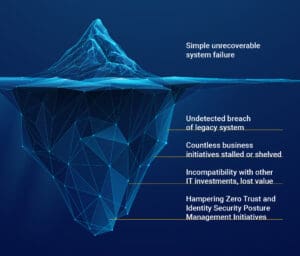
The risk of retaining legacy platforms in your IT organization is akin to the threat of an iceberg. Only 20% of the risk is immediately visible. 

Rationalization often leads to discussions like this: 

  • “What if it shuts down? We will just restart it like always.” 
  • “What if it does not restart? It always has restarted, so stop worrying.” 
  • “What critical systems are totally dependent on it? Good question; nobody knows. Shut it down and find out.” 
  • “We will never get budget for good housekeeping. I have no way to justify the cost and effort.” 

So, on a wing and a prayer, your organization limps along, dependent on a legacy system that is likely out of support, end of life, not updated with the latest security patches, undocumented, and heavily customized by a team who has long since retired. 

The risk of hitting the exposed part of an iceberg seems a bit insane, but is rationalized by a risk, cost, and benefit analysis. But the analysis only takes into account the 20% of the iceberg that is exposed. The Titanic did not hit the part of the iceberg floating above the water line: it hit the iceberg hiding invisible under the surface and far harder to avoid. 

What is the Risk Lying Under the Surface if You Choose to Continue Operating Legacy Systems Beyond Their Lifespan?

The first is obvious: what if it stops and will not restart? Two things immediately happen: 

  1. Everyone finds out what business-critical systems were dependent on the legacy platform. 
  2. LinkedIn profiles start getting updated. 

Short of Catastrophic Failure, the Costs Are Still Compelling

In order to build a business case for modernizing your IT infrastructure, more is needed than simply, “What if…” Luckily the list of justifications, risk reductions, and business benefits grows quickly: 

  • Unmanaged, unaudited, and unmonitored systems are the playgrounds of cyber criminals: 90% of all breaches start with a compromised identity. These legacy platforms are just too vulnerable to leave in the wild
  • The modernized solution has ongoing vendor support, which is patched, secured, and documented
  • Modernization brings with it updated, standards-based protocols and seamless integration with modern authorization (OAuth, OIDC), data synchronization (SCIM 2, REST), and APIs facilitating comprehensive integration into the identity fabric
  • Modernization is a critical part of modern identity security initiatives such as Identity Security Posture Management, Identity Threat Detection and Response, Shared Signals, and a myriad of other new standards building more comprehensive layers of defense
  • Simplification of complex legacy workarounds that were necessary 10 years ago now only slow performance and hamper innovation
  • Turn the legacy platform from a bottleneck or outright killer of business innovation into an enabler of digital transformation, Zero Trust, and Identity Security Posture Management
  • Become an ROI multiplier by decreasing integration costs across all identity management platforms, while increasing the reach and impact of all Identity Data Management investments
  • Future-proof the identity infrastructure by providing a scalable, platform-agnostic, schema-agnostic, standards-based foundation that freely evolves with the industry
  • Generate a true 360-degree view of identity across human and non-human accounts alike that enables cybersecurity across all doors and windows
  • Easily integrate layers of governance, controls, roles, policy-based access, and compliance to meet audit requirements but also strengthen the attack surface
  • Enable near real-time identity updates to ensure that all decisions are made using the most current and accurate information from relevant sources of truth across the company
  • Identity data and processes previously trapped in the legacy system are now free to integrate with and participate in the complete hybrid on-premise and cloud environments

There are more benefits that become obvious as the shackles of legacy platforms are taken off the IT team.

The Danger You Can See, and the Danger You Cannot

Image of iceberg representing the hidden costs of unaddressed identity data cleanliness.

This all sounds good, but why don’t I clean my garage? I know I should, and I can see the benefits and the risks. I can even justify investing precious weekend time to start the project. But week after week, my eclectic collection of legacy “crap” persists. 

In the face of a challenge without a simple or fun solution, it is human nature to defer, procrastinate, distract, and deprioritize. So, the solution is to find that simple, proven, and tangible method to modernize your legacy IT infrastructure without creating more pain. And until now, this option has seemed unattainable. 

How to Navigate Iceberg Invested Waters. With a Map and a Plan

The key to achieving these goals is the need for a modern, platform-agnostic solution that will work with the complete variety of identity management solutions.

Given the variety of siloed data, a schema-agnostic solution easily allows integration across disparate systems. Adding scalability and a nondisruptive approach completes the package. Part of the journey choreographed by Radiant Logic’s Identity Security Posture Management maturity framework is the systematic replacement and modernization of legacy platforms historically threatening our customers.  

The effort can span brand name products such as Microsoft Identity Manager (MIM), Oracle ODSEE, eDirectory, CA, Tivoli, and other LDAP directories, Maxware, SymLabs, and Optimal virtual directories. More generic legacy infrastructure such as SQL databases and flat files can be brought into highly available, modern protocol aware, auditable structures. 


Act Tactically but Implement Strategically

All the benefits outlined previously are available, along with methodologies that support different models for modernization with a focus on business continuity, security, and cost effectiveness. Once the migration is completed, the new Radiant Logic infrastructure becomes a contributing component of both the Zero Trust Architecture and Identity Security Posture Management. Removing the vulnerabilities and constraints of the legacy platforms increases their security and value. Bringing the managed identity data into a modern compatible platform opens up a myriad of potential for leverage, insight, and value. 

If my kids hired a professional garage organization company that could bring fresh eyes, an objective perspective, modern storage systems, and a bright and cheery disposition, I might well tackle my decades of “I might need that someday” hoarding. Maybe I will suggest it as a present to them as much as to me. Living the stress of my unaddressed legacy storage challenges, I can identify with your similar stress if you are living with legacy platforms in your IT infrastructure. Good luck and best wishes for a swift resolution. 

A glowing blue shield icon overlays a digital background of binary code, symbols, and pinkish-purple light, representing cybersecurity or data protection.

The Hidden Trick Hackers Hope You Never Discover

March 26, 2025/in Blog Akshay Srinivas Rajanbabu/by Josue Ochoa

The Risk Lurking Within Your Environment 

Hackers do not want you to wake up to the vulnerability that your unmanaged service accounts have created in your environment, because if they did, they would lose one of their best attack vectors against your organization. 

Hackers focus on finding weaknesses that they can exploit in your company’s IT defenses. When we were all safe inside the same building, the primary defense used to be firewalls. Now, in the distributed world where users can connect from anywhere, these attacks focus on identity. Every identity in your organization is a potential target for hackers. Once an account is compromised or taken over, a skilled cyber-criminal can escalate access, exploit additional vulnerabilities and extract a high price in both hard dollar costs and reputation. 

Key Takeaway: Every unmanaged identity—including service accounts—can become a silent doorway for attackers.

The Blind Spot in IT Security 

Understanding this shift towards focusing on identity, organizations have invested heavily in securing their identities and the accounts associated with them. The common practice is to focus on accounts associated with human beings. These seem more tangible and can be tied back to a user with a title, in a role, in a department, with a manager. These familiar concepts lend themselves more easily to the models for role management, access reviews, and automated onboarding and offboarding. Implementing measures to manage and secure these user accounts is an out-of-the-box functionality for most IDM and IGA products.

Human Accounts Get the Attention—But Machines Hold the Keys

If you lived in a house in a bad neighborhood and only put locks on your doors, would you feel safe? Would you trust that no one could break into your home? Unfortunately, the answer is a resounding no. To feel completely protected, you would need to not only secure the doors but also bar the windows. This is why managing only the human accounts on your network is only a small part of IT security and leaves your organization highly vulnerable to compromise. 

What are the windows in this example? If you are not sure, we have made our point.

Service Accounts: The Overlooked Identities in Every Organization

Service accounts are the blind spots in your IT security program. Unmanaged service accounts are a bigger attack surface than the entirety of your human identities.

Unlike human accounts, service accounts operate in the background. The takeover of a service account may go completely unnoticed because it will not disrupt a user’s personal access, which would raise a red flag.

Key Takeaway: Because service accounts operate invisibly, their compromise often goes undetected—making them prime hacker targets.

Why Service Accounts are Easy Targets 

Service accounts often have elevated privileges used by various applications to access and manage valuable resources. Many times, the same service account is used over and over by internal development or integrators to provide access across multiple applications and systems.

Common Weaknesses Found in Unmanaged Service Accounts

Service accounts bring unique challenges to IT security due to their vulnerabilities and lack of oversight:

  • Often rely on static and shared passwords, rarely rotated, if at all.
  • Proliferate uncontrollably, much like unmanaged groups.
  • Frequently lack documentation on their purpose, access, or ownership.
  • Contribute significantly to IT debt, making clean-up efforts tougher.
  • Are often overlooked or pushed aside in security initiatives.
  • Create a weak link in the IT security chain when vulnerabilities combine.

Take Steps to Address Service Account Vulnerabilities 

The service account vulnerability calls for focused identity data hygiene. This is a two-step process. The first is to “Get Clean.” The second is to “Stay Clean.”

Getting clean starts with visibility and analysis. All the service accounts spread across the organization must be identified and evaluated. This is done through a series of discovery processes that collect and catalog existing service accounts. It combines existing tools and an aggregation and governance solution that operate in the specific world of service accounts. A set of controls is then applied to the inventory of service accounts to determine the relative health of each and answer questions such as:

  • Which accounts have or do not have an owner?
  •  Is the owner still with the organization?
  • Do they have a comprehensive description?
  • Of what groups are they a member?
  • What access do they have to permissions and applications?
  • How often does the same service account reoccur across the enterprise?
  • Are there logs of access history that will indicate which service accounts are active and which are abandoned?

Peer analysis then can be used to start to fill in the blanks. An example would be uncovering that three service accounts have similar group memberships and application access to others in this department owned by this current manager, implying similarity. Utilizing a service account review process that can both extrapolate missing data but also kick off a verification from the intended target which ensures the clean-up is actually accurate. This is a journey that takes a lot of time and interaction. Implementing processes that can run campaigns that are delegated closer to the potential owners will start to raise the sunken ship from the depths.

Four Steps to Staying Clean

As the existing service account mess is being cleaned up, it is critical that all ongoing and new service accounts be fully managed to ensure that they are “Staying Clean.” Implementing and managing a service account lifecycle is critical to maintaining a clean environment.

How to Maintain Continuous Hygiene for Service Accounts

  1. Create a Workflow: The creation of a service account needs to be included in a workflow that requires complete documentation of the owner, descriptions, use, and access granted to the service account.
  2. Retire Inactive Accounts: Moreover, service accounts should be retired when they are no longer used instead of being reused for different purposes.
  3. Transfer Ownership: When an owner leaves the organization or changes roles, his managed service accounts must go through the same transition to a new owner who accepts responsibility for these accounts.
  4. Password Rotation: This practice needs to be implemented, and service accounts that contain privileged access should be added to the Privileged Account Management platform to ensure that additional level of security and visibility.

Stop Overlooking the Orphans of IT Security

In many ways, service accounts are the orphans of IT security, often forgotten and mistreated. They operate unseen in the background, making them easy to overlook but no less critical to protect. Despite their invisibility to end-user operations, these accounts frequently hold elevated privileges, granting them access to sensitive systems and data stores. This makes unmanaged service accounts a prime target for cyber-criminals, offering a hidden pathway to exploit vulnerabilities, escalate permissions, and cause damage that can compromise the organization’s security posture. Ignoring this silent threat doesn’t just impair IT hygiene; it risks the entire organization’s infrastructure.

Failing to address the weaknesses of service accounts means leaving a gaping hole in your security strategy while exposing your systems to unnecessary and avoidable dangers. The good news is that advancements in governance applications have paved the way for more thorough management and oversight of service accounts.

These tools now extend the familiar frameworks used for human account management, offering systematic clean-up processes and lifecycle solutions tailored specifically to service accounts. By bringing these shadow accounts into view, organizations can implement consistent ownership, rigorous documentation, and robust access controls, drastically reducing their exposure to threats. It is time for service accounts to step out of the shadows and take their rightful place as a core element of IT security, transforming them from hidden liabilities to fully managed assets.


A close-up of a human face, digitally enhanced with glowing blue and orange dots and lines, focusing on the eye, evoking a futuristic or cybernetic theme.

The Identity Security Paradox: When More Tools Create Bigger Blind Spots

March 19, 2025/in Blog John Pritchard/by Josue Ochoa

As I prepare for Gartner IAM UK later this month, I find myself confronting an uncomfortable truth that many security leaders are reluctant to acknowledge: The massive investments organizations are making in identity security tools are paradoxically creating more vulnerabilities than they solve. After years in the Identity market advising Fortune 500 CISOs, I’ve observed that the relentless pursuit of new detection capabilities has created a dangerous industry blind spot – one that sophisticated attackers exploit with ruthless efficiency.

The Paradoxical Security Arms Race We’re Losing 

You’ve likely experienced it firsthand: the executive board meeting where everyone nods in agreement as you showcase your latest identity threat detection investments. New alerts, new dashboards, new “AI-powered” capabilities that promise to spot the needle in the haystack. The board feels protected. Your team feels empowered.

Yet breaches continue at an alarming rate.

Identity security fundamentally has a data problem. The industry lacks standards on data models and identity data silos exist across fragmented, disconnected systems. Even modern IAM solutions lack the ability to normalize and correlate identity data across a hybrid enterprise. This fragmentation weakens security posture resulting in greater vulnerability to identity-based threats.

The paradox is painfully simple but rarely discussed: by focusing obsessively on detection while neglecting the integrity of the underlying identity data itself, organizations have built sophisticated security castles on foundations of sand. Every specialized security tool added to the enterprise ecosystem creates its own silo of identity data—each with a partial view of the identity landscape but none with complete visibility. As these tools proliferate, they create a false sense of coverage while critical identity risks fall through the cracks between systems. The irony is striking: the very tools meant to improve visibility often obscure the complete picture.

The Hidden Attack Vector Your Tools Can’t See 

The most dangerous aspect of this paradox is what I call the “identity visibility gap” – the dangerous blind spot created when organizations lack a comprehensive, accurate view of their identity ecosystem.

This gap exists not because organizations don’t care about security, but because traditional approaches to identity management weren’t designed for today’s complex, distributed environments.

Today’s threat actors know they no longer need to defeat your detection systems directly. Instead, they exploit the seams and inconsistencies in your identity data itself – the places where different systems have conflicting information about the same identity. These inconsistencies create shadow zones where attackers can hide in plain sight.

This identity visibility gap becomes exponentially more dangerous when we consider the explosive growth of machine identities. These non-human identities—service accounts, API keys, application credentials, and cloud workloads—are multiplying at 3-5 times the rate of human identities due to automation, DevOps practices, and increasingly, GenAI implementations.

Unlike human identities, machine identities rarely “leave” the organization. Instead, they grow over time, often with privileges that far exceed their essential operational requirements. The most concerning pattern? These machine identities form complex, undocumented webs of interconnection. A compromised low-privilege service account in one system can often provide lateral movement paths to critical systems through inherited or transitive trust relationships no human administrator fully understands. These “ghost roads” through your infrastructure represent the attack paths of choice for sophisticated threat actors.

The Uncomfortable Math of Identity Security Investment 

The math is uncomfortable but undeniable. Gartner’s 2024 report highlights that poor identity hygiene is the primary enabler of identity-based attacks, as attackers exploit inconsistencies and gaps in identity data. Despite this, organizations allocate approximately 80% of their budgets to detection and response tools, leaving less than 20% for prevention and hygiene measures.  

I would argue that even today’s approach to AI in identity security falls woefully short. Most “AI-powered” identity security tools simply flag statistical anomalies: “This user accessed System X at an unusual time.” This surface-level detection is the equivalent of a home security system that can tell you a window is open but can’t determine if it was forced.

This 80/20 detection-prevention imbalance creates a vicious cycle: poor identity data quality leads to excessive false positives in detection systems, which drives investment in more sophisticated detection tools, which then generate more alerts based on the same poor-quality data. Meanwhile, the underlying vulnerability – fragmented, inconsistent, and often outdated identity data – remains unaddressed.

A Combined Arms Approach: A Radical Rethinking 

In military operations, a “combined arms” doctrine is a strategy that recognizes that different capabilities, like infantry, armor, artillery, engineers, and aviation, must work in concert to achieve victory. This approach recognizes that no single arm or capability can decisively defeat a determined enemy on its own, especially in complex and dynamic battlefields. Identity security is no different. It requires balancing and integrating complementary capabilities rather than relying heavily on any single approach.

We need a combined arms framework that fundamentally rebalances identity security around two equal forces: Identity Security Posture Management (ISPM) for prevention and Identity Threat Detection and Response (ITDR) for detection.

ISPM functions as your defense, proactively assessing and strengthening your identity infrastructure to catch vulnerabilities before attackers exploit them. ITDR operates as your offense, hunting down threats in real-time and responding swiftly when identities are compromised or misused.

The critical insight is that these capabilities must operate from a foundation of high-quality, unified identity data to be effective. When identity data lacks completeness, accuracy, and timeliness, even the most sophisticated security tools become compromised in their effectiveness. This fragmentation creates dangerous blind spots that sophisticated attackers eagerly exploit.

Data-Centricity: The Missing Foundation 

The core challenge isn’t a lack of security tools—it’s a data problem. Most organizations suffer from fragmented, inconsistent, and often outdated identity data scattered across numerous repositories. Weak identity posture creates major gaps through over-permissioned accounts that unnecessarily expand the attack surface, orphaned accounts that maintain lingering access long after users leave, and identity sprawl with unmonitored identities scattered across cloud, SaaS, and internal systems.

As Gartner noted in their 2024 report on identity hygiene, good data is key in limiting the identity attack surface. In practice, this means organizations must ensure identity records (accounts, credentials, entitlements) are accurate and up-to-date to shrink potential breach points. Without this foundation, security tools operate with incomplete information, significantly reducing their effectiveness.

What does a data-centric approach to identity security actually look like in practice? It begins with three core capabilities that together form the foundation of truly effective identity security:

1) Real-Time Identity Data Lakes: Visibility Before Action

True identity security begins with consolidated visibility – not just periodic snapshots, but a real-time, complete view of your entire identity ecosystem. This approach differs radically from traditional perimeter-focused security by creating a unified identity intelligence layer that spans all identity repositories.

A global healthcare provider implemented this approach and discovered previously unknown machine identities with excessive privileges across their environment. These machine identities had been created by various operational teams over years without centralized oversight or governance. The most alarming discovery? Their existing security tools had completely missed these identities because they were looking for suspicious behavior, not missing or incomplete identity data.

2) AI-Powered Identity Analytics: Finding Patterns Humans Miss 

The second critical component involves leveraging artificial intelligence to transform raw identity data into actionable security intelligence. While everyone talks about AI in security, few are applying it to the most fundamental element: understanding the relationships and patterns within identity data itself.

Sensemaking of complex data relationships is a key strength of GenAI, a topic I discussed during last year’s Identiverse Keynote. However, all AI capabilities are limited to the breadth and quality of the data they can see. Incomplete or worse, inaccurate data will lead to misinterpretation by even the most advanced AI capabilities. When provided with comprehensive and accurate identity data, AI analytics can identify subtle but significant patterns such as excessive privilege accumulation which would otherwise remain undetected for years. Patterns like these will not be obvious in any single system but become apparent when analyzing the comprehensive identity data lake.

Effective AI for identity security must go beyond anomaly hunting to relationship mapping. This means:

  • Semantic understanding: Rather than treating “Admin” roles across systems as unrelated entities, advanced AI can understand their equivalence despite different naming conventions.
  • Temporal analysis: Identifying permissions that have drifted over time, creating toxic accumulations of access that would never be granted at once but accrue gradually.
  • Risk correlation: Connecting identity attributes with vulnerability data to identify which excessive permissions create actual attack paths versus theoretical risks.

By addressing the systemic data visibility issue, organizations significantly improve their security posture and reduce the attack surface.

3) Continuous Resilience: Beyond Detection to Adaptation 

The final capability involves building continuous resilience through proactive identity security practices that adapt to emerging threats. Instead of point-in-time assessments, this approach implements continuous monitoring and automatic remediation processes.

A global retailer implemented our continuous resilience framework and reduced their response time to identity-related security incidents from days to minutes. When a potential compromise was detected, their security team had immediate access to complete identity context – seeing all the user’s accounts, entitlements, access patterns, and risk factors across every system – rather than manually gathering this information from multiple sources during an active security incident.

The Future of Identity Security: My Controversial Prediction 

Looking ahead to 2027, I’m making a prediction that may seem controversial: the identity security industry will experience a major market correction as organizations realize that their massive investments in detection tools built on poor-quality identity data have created more risk than they’ve mitigated.

In “Predicts 2024: IAM and Data Security Combine to Solve Long-Standing Challenges” Gartner suggests that by 2026, “organizations adopting top data practices within their IAM program will realize 40% improvement in time-to-value delivery for IAM and data security program objectives”. I believe this understates the impact. Organizations that balance prevention and detection on a foundation of high-quality identity data will see not just incremental improvements but transformative change in their security posture.

We’ll Witness Several Major Shifts: 

  1. First, identity data will be recognized as critical infrastructure, deserving the same level of investment and protection as traditional security components. Forward-thinking organizations are already building dedicated identity data operations teams that cross the traditional boundaries between security, IT, and compliance.
  2. Second, AI will revolutionize how we manage identity security, but not in the way most vendors currently claim. Rather than simply detecting anomalies faster, truly advanced AI will help organizations understand and manage the quality, completeness, and relationships within their identity data itself.
  3. Finally, we’ll see a convergence of identity and data security platforms, as Gartner predicts that “by 2027, 70% of organizations will combine data loss prevention and insider risk management disciplines with IAM context to identify suspicious behavior more effectively.” This convergence will eliminate the artificial boundaries between these domains that attackers have exploited for years.

Breaking the Paradox: The Path Forward 

The path to breaking this identity security paradox requires a fundamental shift in thinking. Instead of treating identity data as a byproduct of security processes, we must recognize it as the foundation of effective security itself.

By adopting a data-centric approach to identity security – one that emphasizes the quality, completeness, and timeliness of identity data – organizations can significantly reduce their attack surface and strengthen their overall security posture. In an era where identity has become the primary security battleground, this approach represents the most effective strategy for defending against increasingly sophisticated threats.

As you assess your own identity security investments, I urge you to ask yourself: Are you perpetuating the identity security paradox by pouring more resources into detection while ignoring the data quality issues that undermine your entire security architecture?

In my next blog, “Breaking the Identity Security Paradox: Building a Data-First Architecture,” I’ll share specific implementation strategies for organizations looking to rebalance their identity security approach, including detailed case studies from global enterprises that have successfully made this transition. I’ll also explore how the coming wave of AI in identity security will fundamentally change how we think about protection, detection, and response.


 

Page 3 of 13‹12345›»
Radiant Logic | Unify, Observe, and Act on ALL Identity Data
Request a Demo
  • Solutions
    • Security
    • Governance & Compliance
    • Operations
    • Industries
  • RadiantOne Platform
    • Identity Data Management
    • Identity Observability
    • Identity Analytics
    • AIDA
    • Getting Started
    • Integrations
  • Why Radiant Logic
    • Identity Security Posture Management
    • Identity Data Fabric
    • Identity Visibility and Intelligence Platform
    • Partners
  • Company
    • About Us
    • Leadership
    • Careers
    • Security Practices
    • News
    • Contact Us
  • Support
    • Professional Services
    • Training & Enablement
    • Customer Experience
    • Software Support
Resources
  • -
    • -
      • Resources Library
    • -
      • Blogs
    • -
      • Events
    • -
      • Glossary
    • -
      • Developer Portal
      • Partner Academy
  • Solutions
    • Solutions Overview
    • Security
    • Governance & Compliance
    • Operations
    • Industries
  • RadiantOne
    • RadiantOne Platform Overview
    • Identity Data Management
    • Identity Data Observability
    • Identity Analytics
    • AIDA
    • Getting Started
    • Integrations
  • Why Radiant Logic
    • Why Radiant Overview
    • Identity Security Posture Management
    • Identity Data Fabric?
    • Identity Visibility and Intelligence Platform
    • Partners
  • Company
    • Company Overview
    • About Us
    • Leadership
    • Careers
    • Security Practices
    • News
    • Contact Us
  • Support
    • Professional Services
    • Training & Enablement
    • Customer Experience
    • Software Support
  • Resources
    • Resources Library
    • Blogs
    • Events
    • Glossary
    • Glossary
    • Developer Portal
    • Partner Academy
A blue circular badge with the text AICPA SOC in the center and SOC for Service Organizations | service organization around the edge. The website aicpa.org/soc4so appears below the main text.
  • Linkedin

© 2026 Radiant Logic, Inc. All Rights Reserved. | Privacy Policy